Gas Station Vocabulary for Kids
Gas Station Vocabulary for Kids: Words and Activities gives your child 28 practical terms for fuel stops, cars, payment, and safety. Start with words such as fuel, pump, and full, then add local terms. Depending on the country, people say gas station, petrol station, or service station. Children need not learn every word at once. A small set, concrete examples, and short speaking games build vocabulary during journeys, pretend play, and English lessons.
📥 Gas Station Vocabulary for Kids
Read, match, choose, and practise useful words for a fuel stop.
Leave your email — we'll send the PDF to your inbox.No spam — the PDF plus one short reminder. Unsubscribe anytime.
Essential Words at a Fuel Stop
The table presents regional forms without treating them as mistakes. Choose eight to ten terms first, then add the rest after your child knows that group. Use Gas Station Vocabulary for Kids: Words and Activities for speaking, not as a spelling test.
Gasoline and petrol can name the same fuel, while diesel differs. Children may hear liter, litre, or gallon. Teach the local form and help them recognise the alternatives.
Useful Phrases in Context
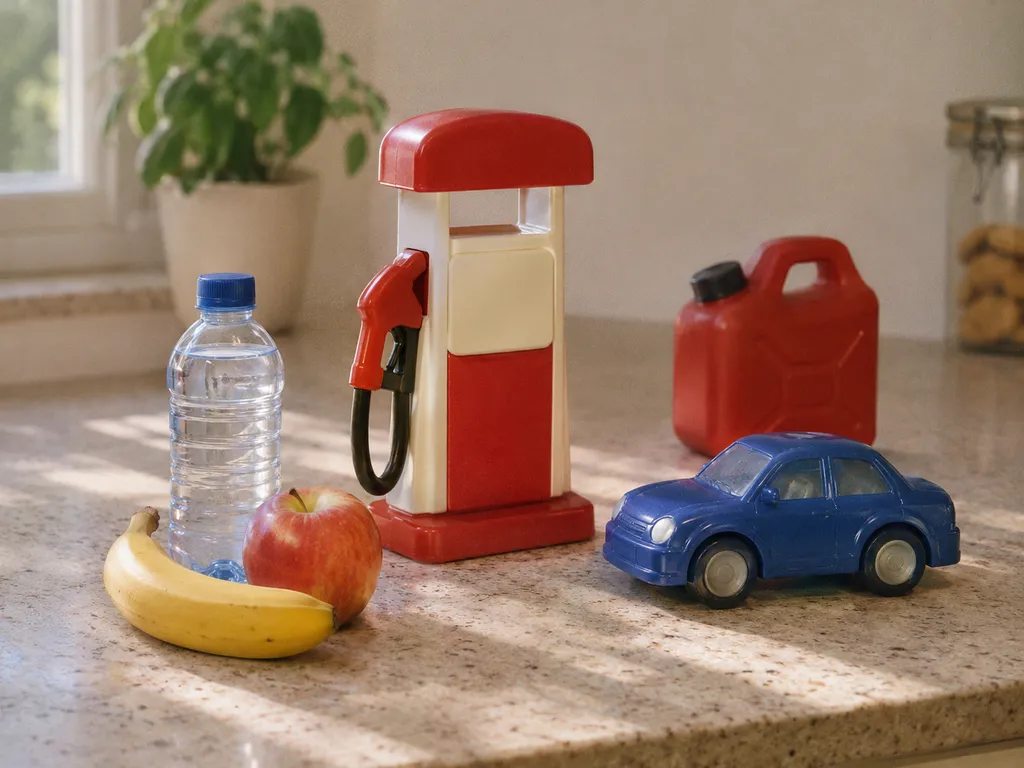
Words stick when placed in short sentences: “The fuel gauge is low,” “We need to stop at a petrol station,” “The tank is full,” and “Please keep the receipt.” Ask your child to point to the matching object or picture.
For a dialogue, one person plays the driver and the other the cashier: “Which pump?” “Pump four, please.” “How would you like to pay?” “By card, please.” Practise meaning and turn-taking rather than copying an adult exchange word for word.
Older children can compare signs or explain a sequence: “First, the driver stops beside the pump. Next, an adult fills the tank. Then, we pay.” Sequence words support longer answers beyond the fuel-stop setting.
How to Introduce the Vocabulary
When using Gas Station Vocabulary for Kids: Words and Activities, begin with a picture, toy car, or view from inside a safely parked vehicle. Name three objects: “pump,” “fuel tank,” and “receipt.” Let your child repeat, find, and use each term in a sentence.
Add contrast pairs: empty and full, arrive and leave, or petrol and diesel. Contrasts define each word. A multilingual child may name the object in another language first. Accept the known idea, then model the English term.
Keep practice brief. Five focused minutes can beat a long list. During LearnLink lessons, our tutors revisit terms through questions, pictures, and role-play, helping children retrieve the same language in varied contexts.
Activities for Different Ages
School-age kids: Build a pretend station with toy cars and paper signs. Give directions: “Stop at the pump,” “Open the shop,” or “Show me the receipt.” Your child can sort picture cards into “car,” “station,” and “payment” groups.
Ages 8–10: Try a missing-word challenge: “The tank is nearly ___,” or “We use the ___ to check the fuel level.” Children can draw a station and label six parts. On the first attempt, choosing the right term matters more than spelling.
School-age kids: Compare terms from two English-speaking regions or plan a fictional journey. Ask when the vehicle needs fuel, which signs the driver should follow, and what a service station might offer. The task adds reasoning without becoming a driving lesson.
Practice Through Play and on Journeys
Turn Gas Station Vocabulary for Kids: Words and Activities into a spotting game. From a safe seat, your child can find a station sign, pump number, car wash, shop, or fuel-price display. Adults must handle all equipment; children observe and describe from safety.
Three-clue Guessing Game
Choose one term without naming it. Give three clues: “It is inside the car. It shows a level. It can point to empty.” Your child answers, “The fuel gauge.” Then swap roles. For younger children, show two picture choices.
At home, make four cards labelled empty, half full, nearly full, and full. Place a toy car beside one card and ask, “What does the gauge show?” Change the card and request a complete answer. This practises vocabulary and sentence form.
Common Mistakes and Simple Fixes
Children may call every fuel gas after learning gas station. Explain regional differences: one speaker says gas, another says petrol, while signs may show diesel or unleaded. Recognition matters more than enforcing one regional form.
Children may mix up pump and nozzle. The pump is the larger machine; the nozzle is its handled part. A labelled picture shows the difference. They may confuse fuel tank with fuel gauge: the tank holds fuel; the gauge shows its level.
Correct errors with a short model. If your child says, “The car is empty,” respond, “The fuel tank is empty,” then continue talking. The correction preserves meaning while supplying a precise phrase.
- Choose five gas station words and model each pronunciation before your child repeats.
- Match five picture cards with pump, nozzle, fuel, cashier, and receipt labels.
- Read a familiar picture book and identify every vehicle or fueling word together.
- Correct one mistake gently by repeating the full sentence with the right word.
- Role-play one gas station visit using a toy car, cashier, and receipt.
When a word has several meanings or pronunciations, Cambridge Dictionary is a useful check before turning it into child-friendly examples.
Frequently Asked Questions
How Many Gas Station Words Should a Child Learn at Once?
Gas Station Vocabulary for Kids: Words and Activities should begin with about eight familiar terms, such as fuel, pump, tank, empty, full, pay, cashier, and receipt. Add terms after your child recognises and uses most of the first set. A small active vocabulary beats a long list the child cannot recall.
Should Children Learn “Gas Station” or “Petrol Station”?
Teach the phrase your child will hear most, but introduce both forms. Gas station appears in certain regions; petrol station and service station appear elsewhere. Present them as regional variations, not right and wrong answers. Children will understand more books, videos, signs, and speakers.
Can We Practise This Vocabulary During a Real Fuel Stop?
Yes, provided your child watches from a safe place and an adult handles the equipment. Ask from inside the vehicle: “Can you see the pump number?” or “Is the fuel gauge empty or full?” Children must not touch pumps, nozzles, fuel caps, or moving vehicles. Practise language, not equipment use.
What If My Child Already Knows These Ideas in Another Language?
Use existing knowledge as a bridge. Show the object, accept the known word, and add the English term: “Yes, that is the fuel tank in English.” Then use it in a short sentence. Keep the child’s other languages. Linking known ideas to English labels supports respectful practice.
For the next seven days, follow three steps: choose eight words, practise for five minutes daily, and ask your child to use at least three in complete sentences. After the week, retain the familiar terms and add two new ones.
Start your child's English journey today — book a trial lesson with LearnLink.
Stay updated on our latest tips and resources by following us on Instagram LearnLink.